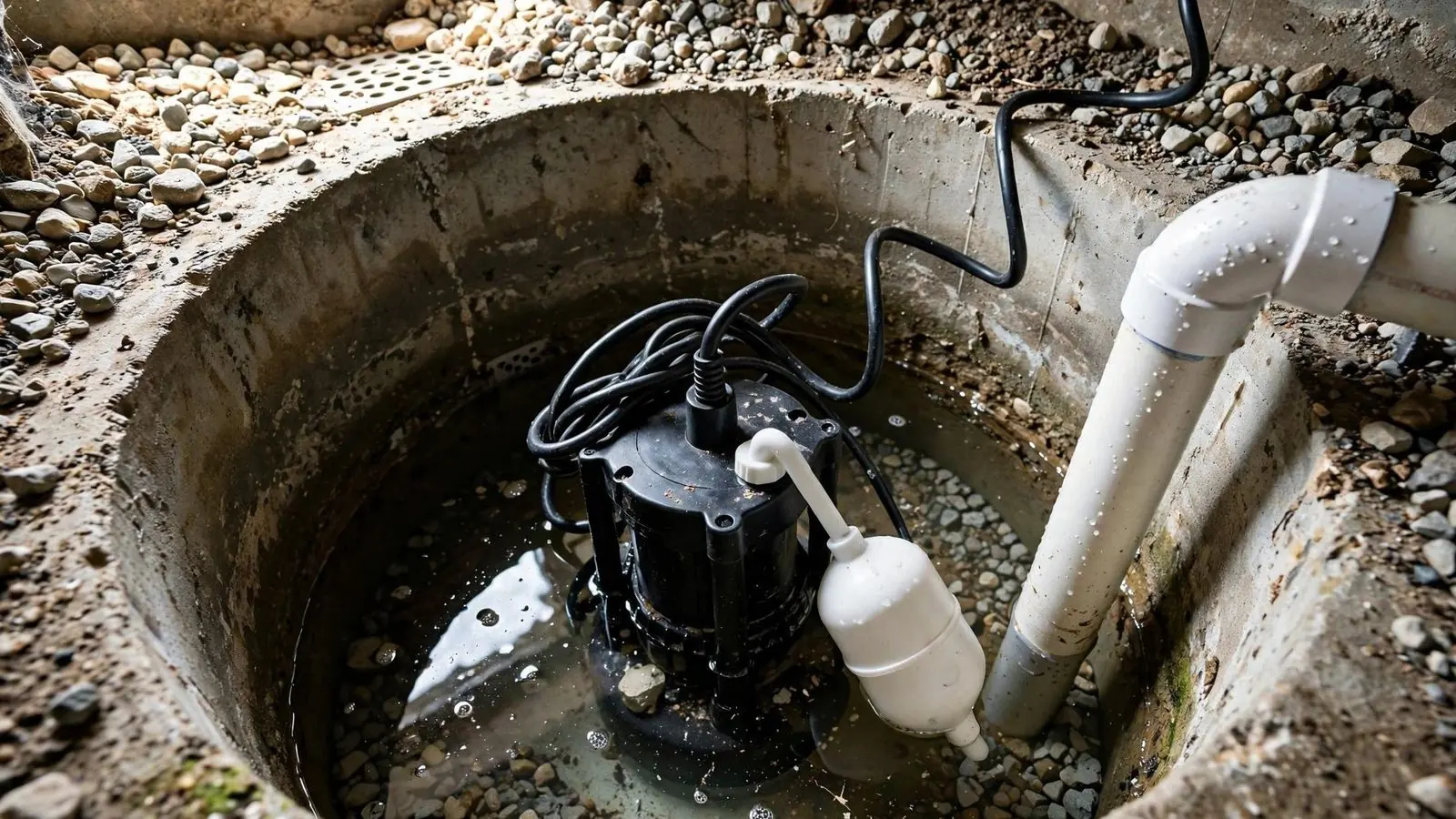
What usually goes wrong with a discharge line
| Failure | Cause | Fix |
|---|---|---|
| Frozen line | Water sits in a low spot or the outlet is blocked by ice | Add pitch, a freeze-resistant outlet, or a relief point |
| Disconnected joint | Ground movement or old couplings | Reconnect with new fittings |
| Crushed or cracked pipe | Lawn equipment or frost | Replace the damaged section |
| Clogged outlet | Debris or ice at the end of the pipe | Clear and cover with a grate |
| Wrong outlet | Discharge sends water where it should not go | Reroute outside or to a storm sewer |
A line that has frozen will often thaw by itself and fail again in the next cold snap. The fix is usually pitch and routing, not a bigger pump.
What decides the cost
- The length of pipe that needs replacement.
- Whether the line is buried, which means digging, or exposed.
- Fittings and check valve condition at the pump.
- Freeze protection features such as a larger-diameter outlet or a relief opening.
- Restoration of lawn or landscaping where the line was dug.
A simple reconnected joint is a short visit. A buried line that needs rerouting is a bigger project. No honest figure can be given without seeing the line, so ask the plumber for the footage, the pitch, and what restoration is included.
Pump runs but the basement stays wet?
Call and describe the discharge line. A plumber can trace it and find the break.
Freeze-proofing a discharge line
Winter is when most discharge lines fail. Water that sits in a flat section freezes and blocks the line, and the pump then pushes against ice. Keeping the pipe pitched away from the house, avoiding low spots, and using a wide outlet reduces the risk.
Ask the plumber about a relief opening a short distance from the foundation, so water has a path if the end of the pipe ices over. The details depend on your yard and how far the line runs. Related drainage work is covered under basement waterproofing.
Checking your own discharge line before you call
Follow the line outside
Walk the route from the basement wall to the outlet and look for gaps, cracks, or disconnected joints.
Check the outlet
Make sure the end is open, not buried in leaves or blocked by ice, and that water flows away from the house.
Run the pump
Pour a bucket of water into the pit and watch the outlet to confirm water leaves the pipe.
Look at the pitch
The line should slope away from the house with no low spots where water can sit and freeze.
If the pump runs and no water appears at the outlet, the blockage is somewhere in between. A plumber can trace the line and find it without digging up the entire yard.
Checking a plumber's license
According to the Minnesota Department of Labor and Industry, plumbing contractors must hold a state license, with a responsible master plumber and a surety bond. The license lookup at dli.mn.gov lets you confirm any plumber before you hire.
What Forest Lake's code says about sump discharge
The City of Forest Lake's code of ordinances, section 52.23, says roof, sump pump, and footing tile water may not go into the sanitary sewer. Sump and footing lines must be permanent and year-round, and run outside the building or to a city storm sewer. Properties found noncompliant can be charged a monthly fee, and the city may inspect.
The code also lets the City Administrator allow discharge to the sanitary sewer from November 15 to March 15 under limited conditions, such as when freezing makes surface discharge dangerous, and the permit requires an inspection in March. The online code notes it may not reflect the latest changes, so call the city before connecting anything. If you live in Wyoming or Hugo, ask your own city for its rule.
Questions Forest Lake Homeowners Ask
The code requires sump discharge to run outside or to a storm sewer, not the sanitary sewer. Ice on streets is a concern, and the code gives the city limited authority in winter, so ask the city about your address.
Water sitting in a flat or low section freezes and blocks the line. Pitch away from the house and a clear outlet help.
Not by default. Forest Lake's code bars it, with a limited winter exception that requires city permission.
The pump runs but the pit stays full, water pools near the foundation, or the line is visibly damaged. A plumber can trace it.
Usually not for wear. Sudden water damage may be covered depending on the policy.
It can be, but a buried line needs a proper pitch and a freeze-resistant design. Many homeowners prefer an exposed line that is easy to inspect.
Sources
- Forest Lake Code of Ordinances, section 52.23 (municipal code)